How to Calculate ROI for Solar Panel Installation: A Step-by-Step Guide
Switching to solar energy—such as installing a rooftop solar system in India—is a practical and forward-looking decision. Beyond environmental benefits, it is a strong financial investment. Like any significant purchase, understanding how much you will save and how long it takes for the system to pay for itself is essential.
This article explains ROI (Return on Investment) for solar panels in India in simple, clear terms for first-time buyers and homeowners evaluating solar options.
What is ROI in Solar Panels?
ROI, or Return on Investment, measures how profitable your solar installation is relative to the money you spend on it. It helps you estimate the annual return and the long-term financial benefit of switching to solar.
For example, if a system costs ₹2,00,000 and saves ₹20,000 per year on electricity, you will have recovered the initial cost in 10 years. Any savings after that period represent net financial gain.
Key Factors That Affect Solar ROI
Several important factors determine the ROI of a rooftop solar system. A clear understanding of these elements helps produce realistic savings estimates:
- System Cost: Includes solar panels, inverter, wiring, mounting structure and installation. In India, rooftop systems typically range from around ₹40,000 to ₹60,000 per kW, though prices vary by brand and technology.
- Electricity Tariff: The higher your current electricity tariff, the faster a solar system delivers financial savings. Areas with higher per-unit charges see quicker payback.
- Panel Efficiency: More efficient panels produce more electricity from the same area, improving overall returns.
- Government Subsidies: Central and state subsidies for residential rooftop solar reduce upfront costs and shorten payback periods.
- Maintenance Costs: Solar systems require minimal maintenance, but occasional cleaning and periodic inverter replacement add to lifetime costs.
The Concept of Solar Payback Period
The payback period is the time it takes for cumulative savings on electricity bills to equal the installation cost. After this period, the electricity you generate is effectively cost-free, apart from maintenance.
For instance, a system costing ₹3,00,000 that saves ₹30,000 a year has a payback period of 10 years. With panels lasting 20–25 years, that typically leaves 10–15 years of lower-cost electricity after payback.
ROI on Solar Panels in India
Typical ROI for residential solar installations in India can range broadly depending on location, electricity consumption and subsidy support. Many households see annual returns in the range of 18% to 25% when calculated on net savings versus net cost. By comparison, traditional bank fixed deposits often yield 6–7% annually, while equities and mutual funds carry higher variability.
Households with higher monthly electricity bills—₹5,000 to ₹10,000 or more—usually achieve faster payback and higher ROI, making solar particularly attractive for high-consumption homes.
How to Calculate ROI for Solar Panels?
The ROI formula is straightforward:
ROI (%) = (Net Annual Savings ÷ Cost of Investment) × 100
- Step 1: Determine the system cost after subsidies.
- Step 2: Estimate annual savings by comparing current electricity bills with expected solar-assisted bills.
- Step 3: Subtract annual maintenance or operating costs.
- Step 4: Divide net annual savings by the total cost of the system.
- Step 5: Multiply the result by 100 to express ROI as a percentage.
Example:
- Installation Cost (after subsidy): ₹2,50,000
- Annual Savings: ₹25,000
- ROI: (25,000 ÷ 2,50,000) × 100 = 10% per year
- Payback Period: 10 years
After the payback period, subsequent savings contribute directly to net returns.
Using a Solar ROI Calculator in Excel
To avoid manual calculations, use a solar payback or ROI calculator, including Excel templates commonly provided by solar vendors. Input your installation cost, subsidy, electricity tariff and estimated generation or savings. The tool will provide annual ROI, payback period and projected lifetime savings.
Such calculators are useful when comparing system sizes—3 kW, 5 kW or 10 kW—and different equipment options, helping you choose the most cost-effective configuration for your needs.
Tips to Maximise Your Solar ROI
Follow these practical steps to improve returns from your solar investment:
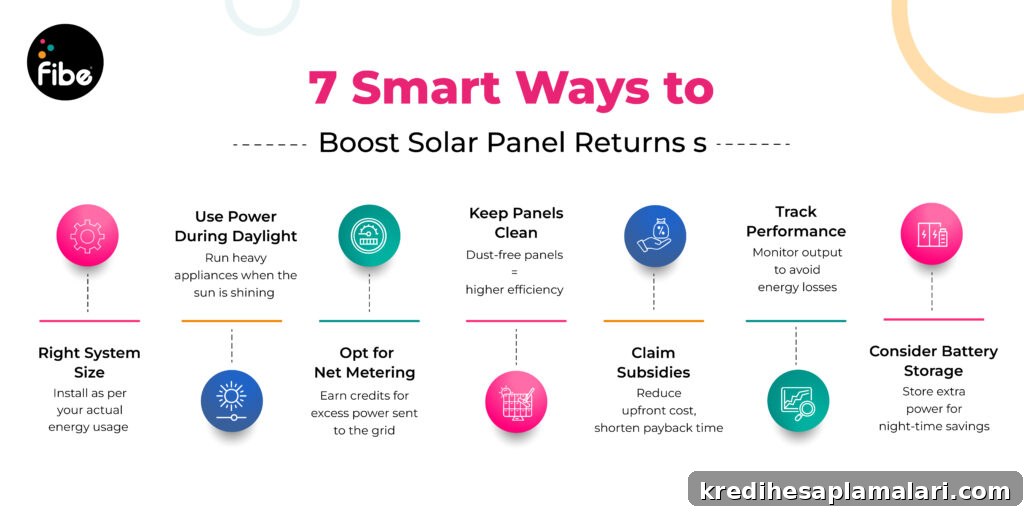
- Choose the Right System Size: Match system capacity to household consumption to avoid underutilization or unnecessary oversizing.
- Shift Usage to Daylight: Run high-consumption appliances during peak sunlight hours to maximise self-consumption and reduce grid draw.
- Opt for Net Metering: Net metering lets you export surplus energy to the grid and receive credit, lowering monthly bills and boosting ROI.
- Perform Regular Maintenance: Keep panels clean and ensure the inverter and mounting hardware remain in good condition. Routine checks preserve efficiency and long-term performance.
Why Solar is a Smarter Investment Than You Think
Solar delivers benefits beyond direct financial returns:
- Energy Independence: Generating your own electricity reduces dependence on the grid and shields you from future tariff increases.
- Environmental Benefits: Solar generation lowers carbon emissions and reduces reliance on fossil fuels, supporting cleaner energy goals.
- Higher Property Value: Homes with solar installations commonly attract higher resale values because buyers value lower operating costs and eco-friendly features.
Final Thoughts
Calculating ROI before investing in rooftop solar in India is essential. Understanding the upfront costs, subsidies, electricity savings and payback period helps you make an informed choice. Tools like solar ROI calculators simplify the evaluation and show when the system will begin providing net returns. Many Indian households recover installation costs within 7–10 years; after that, they benefit from substantial savings as electricity generation becomes effectively low-cost for the remaining life of the system.
FAQs
What is the ROI of solar installation?
ROI for residential solar installations in India commonly ranges between 18% and 25% annually, although actual returns depend on system size, electricity tariff and subsidy support.
What is the 20% rule for solar panels?
The “20% rule” refers to panel efficiency: many high-quality panels convert about 20% of sunlight into electricity, which improves energy output per unit area.
How to calculate solar panel payback?
Divide total installation cost by annual savings. For example, ₹2,50,000 ÷ ₹25,000 = 10 years payback.
What is the average cost of installing solar panels in India?
Costs vary by system size and equipment. Residential rooftop systems typically range from around ₹50,000 to ₹2,50,000, depending on capacity and technology; commercial systems cost more based on scale.
Do I get subsidies on solar panel installation in India?
Yes. Residential users can access central and state-level subsidies under government schemes, while commercial projects often benefit from different incentive structures and tax considerations.
Are there income tax benefits on solar panels?
Yes. If you finance your solar system with a loan, there are tax provisions that may allow deductions on interest and principal under applicable income tax rules—check current regulations and consult a tax advisor for specifics.